LinkedIn Is a Powerful SEO Tool. But Only If You Sound Like a Human.
By Ian Mason • April 20, 2026 •

By Ian Mason • April 20, 2026 •
By Ian Mason • April 20, 2026 • News,
For many years, LinkedIn has been a resource to test the legitimacy of a job posting, or to find colleagues, coworkers or others in the industry to reach out to.
Over time, as people have started using it more frequently, there has been a shift from using one's own voice to talk about work to using AI to automate posting or change one's overall tone. Unfortunately, this has made the overall tenor much more sycophantic than it was previously. At least that is my take on things.
This doesn't change the fact that LinkedIn is still a standard for many companies that want to reach prospective clients, colleagues or future employees. It also has authority with Google. Why does that matter?
LinkedIn is one of the strongest domains on the internet. According to an Ahrefs-based analysis by Foundation, it ranks in Google for about 14.4 million keywords and pulls in roughly 147 million organic visits a month. Your own website would take years to build that kind of authority. A post on LinkedIn borrows it on day one.
What Google rewards on LinkedIn is shifting, though. Traffic to LinkedIn's long-form articles fell 89% between March 2024 and March 2026. Meanwhile, Google traffic to regular LinkedIn posts grew from about 3 million to 11 million visits a month between October 2025 and March 2026. Google is sending people to real posts from real people.
AI search tools lean on LinkedIn heavily too.
Early this year, Semrush analyzed 325,000 prompts across ChatGPT Search, Google AI Mode and Perplexity. LinkedIn was the second most cited domain across all three. About 11% of AI answers pointed to a LinkedIn URL, including 14.3% on ChatGPT Search.
The details of that study matter more than the headline. Original posts earned 95% of LinkedIn's citations, and reshares earned just 5%. Most cited posts had modest engagement, around 15 to 25 reactions. The cited content was usually advice and expertise, not product promotion.
In other words, AI tools aren't rewarding the loudest accounts. They're rewarding people who say something original and useful. That's exactly the kind of content LinkedIn itself is now trying to protect.
For a while, LinkedIn leaned into AI hard. It offered an AI tool that would write your posts for you, and third-party tools promised to comment on dozens of posts a day in your name. The result was a feed that started to sound like one very polite robot talking to itself.
The numbers back that up. An analysis by AI detection company Pangram of public LinkedIn activity from April to June 2026 found that 30% of comments and 41% of long-form posts were fully AI-generated.
Users pushed back, and this year LinkedIn changed course:
LinkedIn hasn't banned AI. It still welcomes AI-assisted content that carries original ideas. But the message is clear: if a machine could have written it for anyone, LinkedIn doesn't want to show it to anyone.
The best LinkedIn content in 2026 has one thing in common. Nobody else could have posted it. It carries a real opinion, a real experience or a real sense of humor. Here are three kinds of content that are working right now.
Comments are the most underrated part of LinkedIn, and the easiest place to spot AI. "Great post, so true!" adds nothing. A comment that shares a quick story, pushes back on a point or asks a smart follow-up question starts a real conversation.
With comments now ranked by relevance, a good comment on a popular post can put you in front of thousands of people who have never heard of you. That's free visibility, and it only works if you write it yourself.
Funny posts do well because they're hard to fake. AI can write a joke, but it can't write your joke about your job.
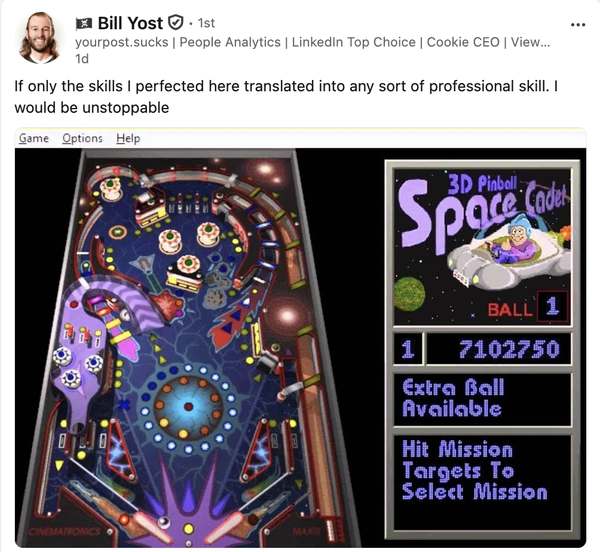
Post by Bill Yost. It drew 152 reactions and 43 comments.
Bill Yost's post above is one line and a screenshot of an old school Windows 95 Pinball game most of his audience grew up with. There's no lesson and no call to action. It works because it's just relatable. Everyone has a useless skill they're weirdly proud of, and 43 comments say people wanted to talk about theirs.
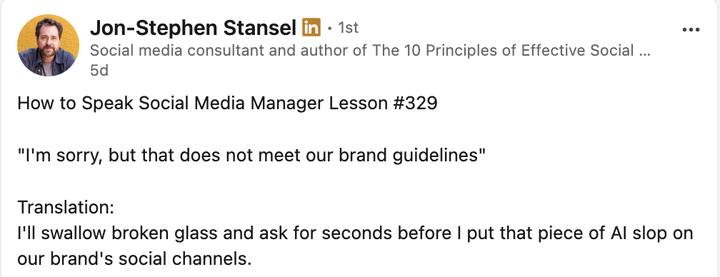
Post by Jon-Stephen Stansel, social media consultant. It drew 385 reactions and 28 reposts.
Jon-Stephen Stansel's running "How to Speak Social Media Manager" bit takes an inside joke from his industry and says the quiet part out loud. It's funny, it's specific, and it lands with exactly the people he wants to reach.
The other content that cuts through is someone with real expertise saying what everyone in the industry is thinking but not saying.
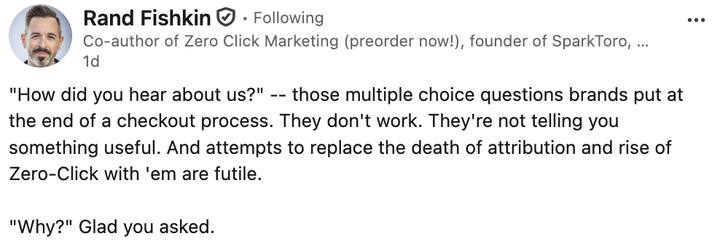
Post by Rand Fishkin, founder of SparkToro.
Rand Fishkin opens by telling marketers that a tool many of them rely on, the "How did you hear about us?" checkout survey, doesn't work. Then he promises to explain why. It's a strong opinion from someone who has earned the right to have one, and it gives readers a reason to keep reading and to argue in the comments.
You don't need Rand's following to do this. A contractor explaining why the lowest bid usually costs more, or an accountant explaining the mistake they see every tax season, is the same move. Share what you know from doing the work.
You don't need to become a comedian or start picking fights. You just need to show up as a real person with real expertise. Here's where to start.
LinkedIn is still one of the best places for your business to get found, by people and by AI tools. But the shortcut everyone took, letting AI do the talking, is now the fastest way to disappear. The advantage belongs to people who sound like themselves.
At MOJO Creative Digital, we help B2B companies and professional services firms build LinkedIn content that sounds like them and gets seen. That includes content strategy, executive thought leadership and ongoing LinkedIn management. Request a quote or call us at (410) 439-1994.
Follow MOJO Creative Digital on LinkedIn for more takes on marketing that actually sounds human.
Ian Mason is a Digital Marketing Specialist at MOJO Creative Digital. Connect with Ian on LinkedIn.
LinkedIn is demoting generic AI content, not all AI use. In May 2026 it announced it would pull low-effort AI posts, engagement bait and bot comments out of recommendation feeds. AI-assisted posts with original ideas are still welcome.
Yes, as an editor. Using AI to proofread or tighten your writing is fine. The problems start when AI supplies the ideas, the opinions or the comments. LinkedIn even replaced its own AI post writer with a proofreading tool.
LinkedIn now ranks comments by relevance, and it says it blocks hundreds of thousands of automated comment attempts every day. Generic comments get buried, and they can make your profile look automated to the people reading them.
Content only you could have written: meaningful comments, humor about your real work, and honest opinions about your industry. Original posts earn 95% of LinkedIn's AI search citations, according to Semrush.
Yes. LinkedIn is one of the most cited sources in AI search tools like ChatGPT and Google AI Mode. Original posts from real experts can put your business in those answers, even before someone visits your website.