People can’t handle AI because they can’t manage people.
By Alexander Fakeri • February 23, 2026 •

By Alexander Fakeri • February 23, 2026 •
By Alexander Fakeri • February 23, 2026 • News,
The evolution of AI development is proving something interesting: the people who succeed most with AI aren’t necessarily the most technical. They’re the ones who know how to manage and direct. Most people look at AI as technology. And originally, that was the barrier. Ten years ago, AI meant coding, binary, mathematics, training datasets—convincing a system what the next logical step should be. It was programming. Today, that’s not the issue. The main complaint you hear now isn’t, “I don’t understand the math.” It’s: “I don’t know what to do with it.” My sister-in-law said something that stuck with me. She said, “It’s like having someone clean your floors, but they don’t know where the cleaner is, they don’t know where the mop is, and every time you tell them one thing, you have to tell them another and another. I might as well just do it myself.” That’s profound. Because that’s not a technology problem, that’s an 'ability to manage' problem.
We are now at a point where the models are trained. The systems are powerful. The access to data is vast. AI learns faster than ever. But what most people are struggling with isn’t programming. It’s delegation. How do we manage AI? Most of us don’t know how to let go of tasks. We micromanage. We need our touch on it. We assume instead of communicating. We give half instructions and expect full outcomes.
And here’s the part most people miss: delegation isn’t binary. It has levels. Most leaders think they’re delegating when they’re really just issuing instructions. And then they turn around and expect AI to operate like a fully trusted operator on day one. That gap is where the frustration lives.
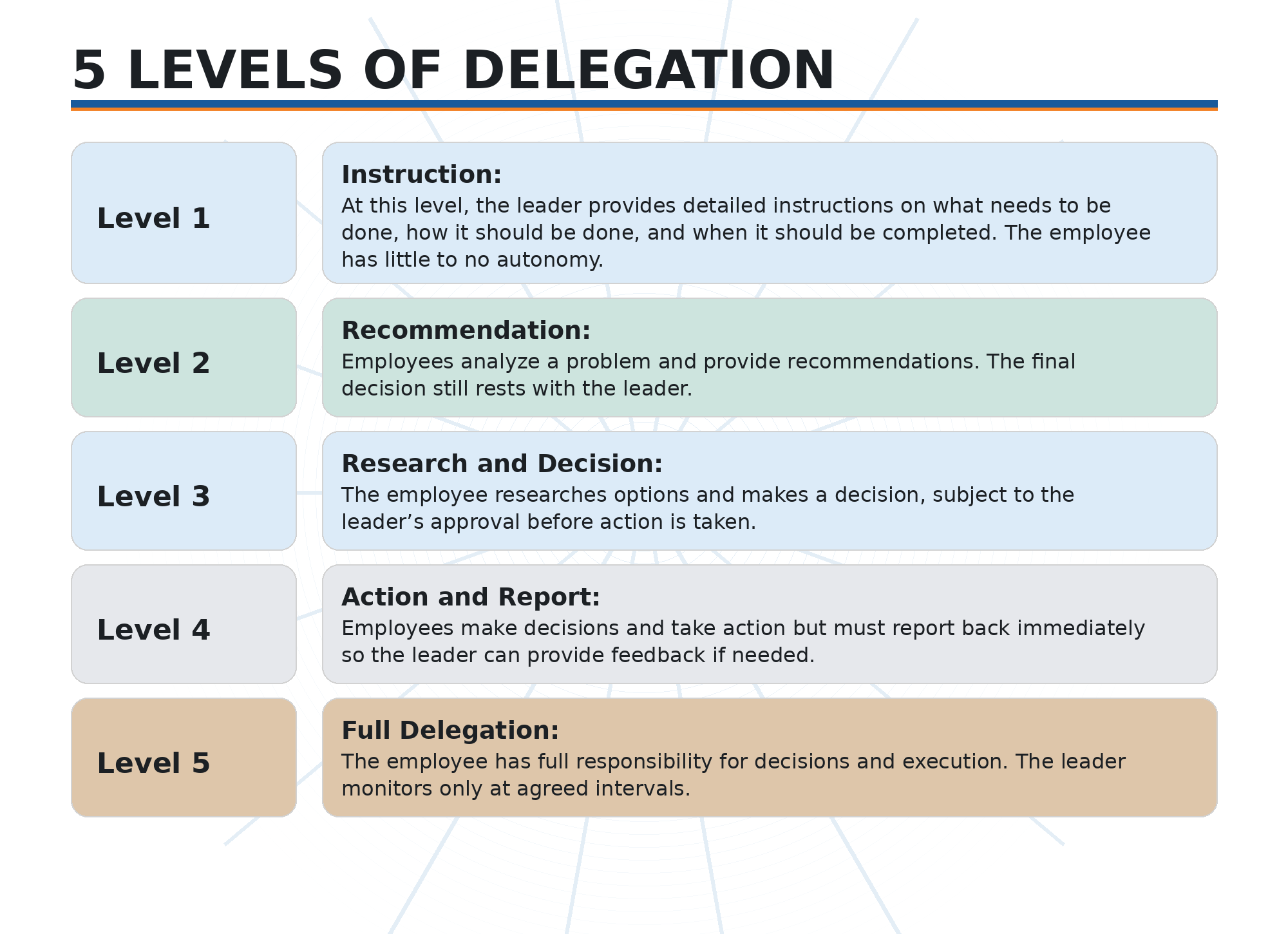
Most people live at Level 1 or Level 2 most of the time—detailed instruction, or “bring me options and I’ll decide.” And then when AI doesn’t instantly operate at Level 5, they’re frustrated and call it a failure.
But here’s the reality: Nearly 75% of employees say their managers are ineffective. About 84% say poorly trained managers create stress. Roughly 82% of managers enter roles without formal training. And only about 10% of people naturally possess strong managerial talent. Managers account for around 70% of team engagement variance. Let that sink in. If three out of four managers are ineffective, if most were never trained, if only a small percentage have the instinct, why would we assume people would automatically manage AI well? Managing AI is managing. It requires clear expectations, complete sentences, specific direction, defined outcomes, patience, feedback, and iteration. It requires leadership. And leadership isn’t common.
So when people say, “AI doesn’t work,” or “It’s frustrating,” it’s not AI failing. It’s leadership failing. The question isn’t, “Can you use AI?” It’s, “Do you know how to manage?” Do you know how to delegate? Do you know how to communicate expectations clearly? Or do you simply not have what it takes—yet? Because this era won’t be defined by who understands code. It will be defined by who understands leadership. And here’s what I believe deeply: The evolution of AI is going to accelerate rapidly—and so must the way we think. As the models continue to learn, and as we learn how to manage them—how to problem-solve differently, how to operate in this new everyday reality—we will be playing at a whole new level. This isn’t just a shift in technology. It’s a shift in capability. And the individuals and business owners who evolve their mindset fast enough won’t just use AI—they’ll outperform everyone who doesn’t.
Leadership Thoughts from Alexander Fakeri